Never pee in running water
When I was a child, my parents and elders had one rule about streams that no one dared break. “Never pee or poop near running water,” they said. “It is a great sin. Your private parts will get infected and rot.”
It worked. I was terrified. For years, I walked well away from every stream before relieving myself, half-convinced the water was watching me.
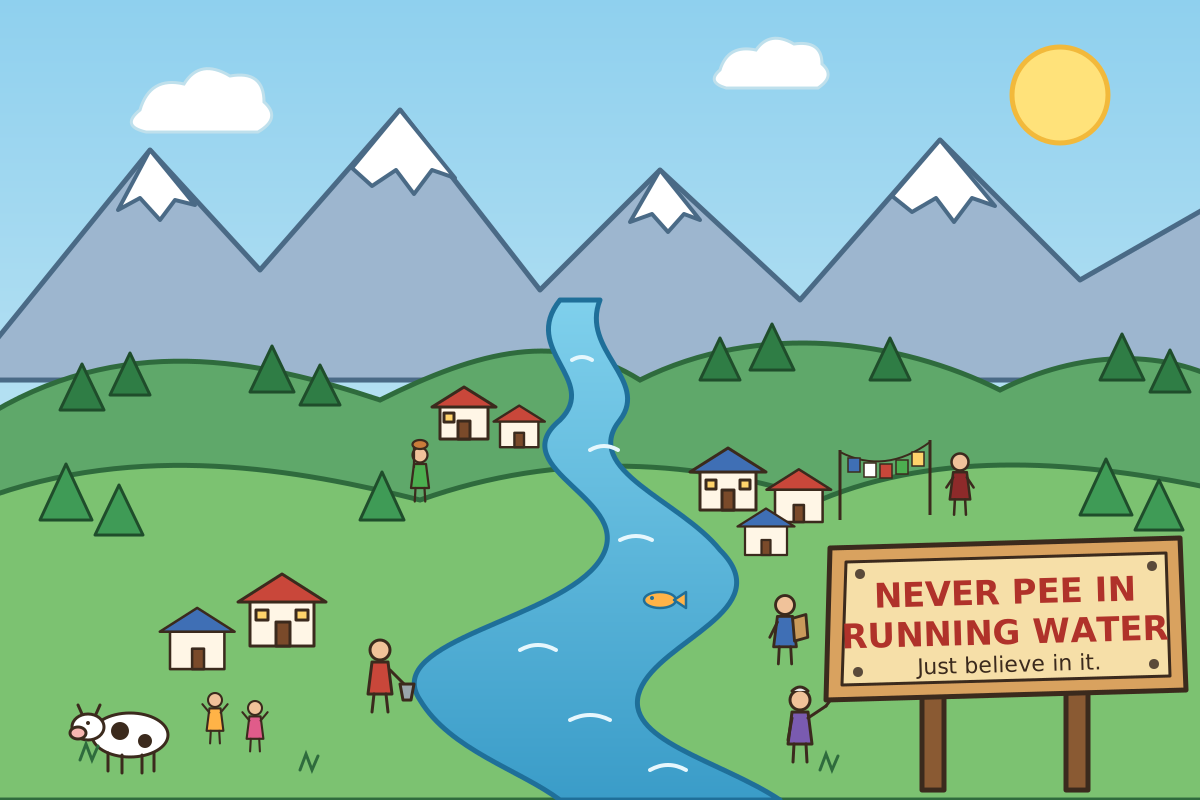
Then I went to school and learned to dismiss it as an illogical superstition. I learned that diseases come from germs, not from sin. Water is non-living; it has no senses and cannot punish anyone. I quietly filed my elders’ warning under “superstition” and felt a little embarrassed that I had ever believed it.
Today, after years of working on rivers and the creatures that depend on them, I have started to believe again that it is a sin to pee in running water. I am not sure whether I am unlearning or relearning. Maybe both. The superstition was not the warning. The superstition was my confidence that it was nonsense.
Everyone lives downstream
Think about what a river is. Rain that falls on one hillside flows past one village, then the next, then a town, and finally reaches the ocean. Whatever goes in upstream does not disappear. It travels, and it builds up. Peeing into a mountain stream is not a private act. It affects everyone downstream: the family filling buckets around the bend, the cattle at the shallows, the fish, the frogs, the entire ecosystem.
My elders never used words like “watershed” or “ecosystem services.” They did not need to. Their rule carried the whole idea in one sentence a five-year-old could remember for life.
The literal part of the warning was not wrong either. Human waste in drinking water makes people sick and can kill them. The World Health Organization estimated that safe water, sanitation and hygiene could have prevented at least 1.4 million deaths in 2019, including 395,000 children under age five.
Even the threat to private parts has an echo in modern medicine. A parasitic disease called schistosomiasis spreads when infected people contaminate fresh water with excreta carrying the parasite’s eggs. One form attacks the reproductive organs of both women and men. My elders had never heard of it, but “foul the water and your private parts will suffer” is a fair one-line summary.
A whole way of seeing the world
What I missed as a student was that the warning never stood alone. It lived inside a whole way of seeing the world.
In Hindu belief, the divine is present everywhere: in water, in rock, in trees and in caves. Natural flowing water is held to be among the purest of things. Many communities in the eastern Himalaya keep a devithan, a sacred seat of the goddess, often beside a spring. In Sikkim, devithans are protected areas around springs, each tied to a local story about why the place is holy, and local rules often reserve the water for drinking only and forbid waste or dirt near the site.
In Himalayan Buddhism, there are the lu, spirits of springs, lakes and rivers. The lu are believed to live in clean, pure and sacred places and to respond to physical and spiritual pollution with long illnesses, such as boils and skin infections. The idea is ancient: humans and the lu live in harmony until people disturb the balance by digging, building, felling trees and polluting water sources.
Different traditions, same lesson: the stream is not ours alone. Treat it as sacred, because something larger than you lives there.
Restraint as a conservation tool
There was a second kind of rule, too: restraint. Certain lakes and caves were simply off-limits at certain times of year. As a child, I took this as a mystery. Now I see a resource conservation tool. Modern resource managers have a dry name for it: a closed season. My grandparents had a better one: respect.
In 2001, ecologists Johan Colding and Carl Folke reviewed taboos worldwide and found that many work much like formal conservation laws but have gone unrecognized in that role. Their great advantage is that people follow them voluntarily, at almost no cost. Some may even be the product of generations of trial and error, much like the “adaptive management” taught in universities today.
That is exactly what my elders gave me. No fines, no signboards, no treatment plant. Just a story strong enough that a child obeys it alone in the forest, with no one watching. Few environmental laws can claim that.
Maybe we have peed too much
Fresh water is becoming one of the world’s scarcest resources. One in four people, about 2.1 billion, still lack access to safely managed drinking water, and 354 million still have no choice but to defecate in the open. As of 2022, roughly half of humanity faced severe water scarcity for at least part of the year. Maybe we have peed too much.
The rule was never only about pee or only about water. Water was simply the easiest place to teach a child something much bigger: do not spoil what you did not create, take only what you need, and use it knowing it is not all for you. The same thinking underlies the sacred grove no one cuts, the lake no one visits in certain months, and the spirit who lives in the spring. Nature was not treated as a resource we own. It was a home we share with the village downstream, the heron in the shallows, the fish, the trees and the rocks, and with generations not yet born. We are not its owners, only one of its many users.
I think traditional beliefs are secretly scientific. Not every traditional belief holds up to scientific testing, and not every one needs to. But many carry deep knowledge and wisdom. Perhaps we should judge such wisdom by its results rather than its vocabulary. By its results, this one was a remarkably effective system for managing water and wild places, one even a child could understand and follow.
So, let’s stop peeing in running water, once again.
Comments